|
Code: 15AYR
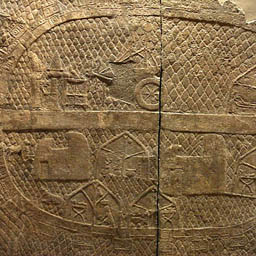
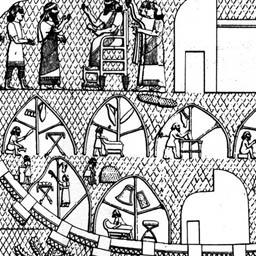
On the right you can see some of the original contemporary source image of the Assyrian base camp from which the siege of Lachish was conducted. It is fortified and has a road through the middle. Servants are at work in tents. A priest performs a ceremony in front of chariots on which are visible the symbols of the gods. There are several other depictions of the tents, and some is quite detailed, but we still haven't managed to agree on exactly what sort of structure
they actually represent...
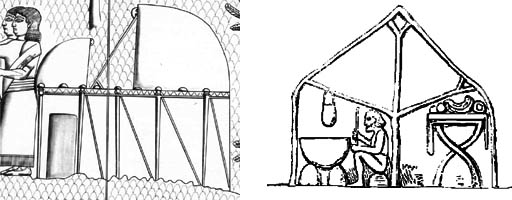
The tents seems just like modern bedouin ones, where one side is open and angled to catch cooling breezes. The other 'type' is probably a screen, around two such tents arranged to face each other and seen from the side. These are probably tents for high officials and for the king. They would be made of goat hair, as are modern ones, and they'd be black. The screen is for privacy. In many other reliefs this is quite clearly depicted as a courtain enclosure, made of fabric panels stretched between poles with decorated tops,
supported by guy ropes, similar to that used by Japanese warlords for instance. Often there is a door cut in one of the panels.
Another possible interpretation is that these are completely different tents or even mudbrick houses. In short, the problem is: what tridimensional shape is represented here?
There are several possibilities:
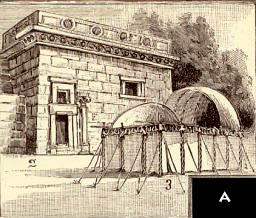
Hemispherical (A)
In this engraving the two tops are interpreted as a cover stretched on a very thin frame, possibly a folding cover like those
used on prams. From a construction point of view, the stretched material could be wool or canvas (linen) while the structure could be made of wood poles bent with steam, using a strong but flexible variety, possibly an imported essence such as elm or birch, wich were the materials used for Egyptian chariots. Joints could be easly made in bronze...
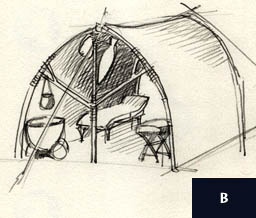
Semicylindrical (B)
This sketch shows the most straightforward option, it takes the front depiction rather literally and used it as guide, assuming the stylized relief images show a rounded up back in the side views, rather than render a realistic perspective, as it's indeed the case with all conventional representation such as these...
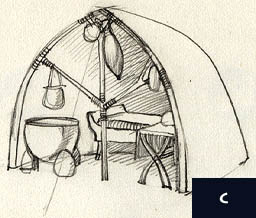
Half ogive or half almond (C)
This sketch shows a variation of the design, assuming the representations are literally descriptive of the actual shape also for the tents seen from the side, as they are of the tent interior, objects and structure.
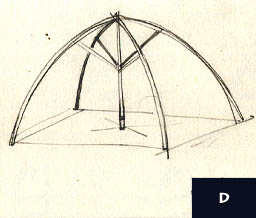
Rounded square pyramid (D)
This is yet another possible structural configuration, it has the advantage of being simple and sturdy from a constructional point of view, and still closely match the representation, both from the front and side.
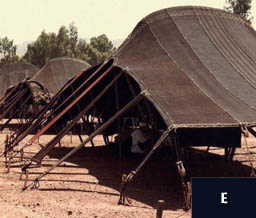
Berber ridge tent (E)
This is a different approach, based on the fact that Assyrian reliefs represent Arab and Assyrian tents identically. These traditional berber tents have the sides hold up by posts planted in the ground at an angle to the central poles, which are perfectly vertical. While not being exactly the same internal structure as that depicted in the reliefs it is still very similar, and it could easily be a later evolution of the same basic design...
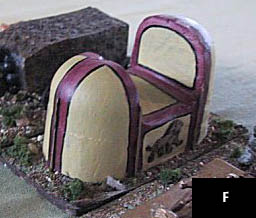
Direct 3D extrusion (F)
This is the straight in the face approach, based on the acceptance of the sources as they are without too much questioning or interpretation. While it can be argued it makes little sense from a constructional point of view, there may have been reasons for doing things this way which we do not know... it must be admitted that's pretty much what the sources shown, and it's quite pretty too! Thanks to the gifted wargamer who crafted this lovely handmade piece (sorry I didn't took note of the name when I stolen this from the web and I can't find it anymore) it's reproduced here without permission, and I would be glad to put credits up if someone knows the author...
|
|
|
|